

From living-wage campaigns to social housing, community-labor coalitions increasingly demand redistribution from local governments in the United States (Martin 2001; Joy and Vogel 2021). As political opportunities shift away from the federal and state levels, local governments have become focal sites for contesting the terms of city life and imagining alternatives (Schragger 2016; Ogorzalek 2021). Urban constituents have elected progressive leaders on explicitly redistributive platforms, most recently Katie Wilson in Seattle and Zohran Mamdani in New York.
But local coalitions and officials pursuing redistribution via taxation face numerous constraints: federalism’s anti-urban bias (Schragger 2021), preemptive state laws designed to blunt local fiscal authority (Scharff 2011), and neoliberal pressures that subordinate public interest to private capital retention (Brenner and Theodore 2002; Peck 2012). What does it take to fight austerity budgets through local tax reform, and to keep redistributive commitments once the tax is won? Drawing on analyses of tax-the-rich campaigns, city council meetings, and interviews, I trace Seattle’s repeated tax reform attempts to address how the city eventually succeeded, and what became of the revenue.
Seattle passed JumpStart, a tax that the city’s largest corporations pay on high salaries, in the summer of 2020, amid a pandemic-induced recession and racial-justice uprisings. Grassroots organizing for the Amazon Tax campaign, led by Councilmember Kshama Sawant and Socialist Alternative, pushed an unusually diverse coalition of over 100 labor, community, environmental, and business organizations, along with homelessness service providers, to rally around JumpStart: Councilmember Teresa Mosqueda’s smaller yet still radical alternative to the Amazon Tax. But the win was a long time in the making. It took four years of organizing, two failed tax reform attempts, and repeatedly shifting coalitions to get there.
JumpStart was especially impressive in that it allowed the city to avoid cuts to essential services, while funding its largest fiscal investment in affordable housing. It now constitutes one of the city’s largest local revenue sources. Over time, though, the city delinked JumpStart from the very commitments that brought it into being, instead transferring a growing share of its revenue to the general fund, toward closing budget gaps.
Seattle’s experience is thus a victory for anti-austerity politics, but with an asterisk: the revenues raised by JumpStart have been siphoned away to strengthen the city’s overall fiscal health. The fiscal capacity built by taxing the rich has proven too valuable for the city to invest entirely in service of the redistribution goals that justified it.
Fiscal capacity and its purposes
This tension between redistribution and other fiscal capacity goals is not unique to Seattle. Neoliberal restructuring has squeezed local budgets nationwide, fragmenting federal transfers and intensifying inter-city competition for funding too often dedicated to specific use (Pacewicz 2016b). Faced with shrinking discretionary revenue and balanced-budget mandates, municipal leaders act like fiscal entrepreneurs, maximizing whatever fungible resources they can secure, rather than earmarking them for specific redistributive goals (Pacewicz 2016a). Redistributive commitments, in other words, can erode even when the policies enacting them remain intact (Hacker 2004; Streeck and Thelen 2005). Yet increased fiscal capacity can also serve redistribution, in both who is taxed and what is funded, especially when it converges with pressures from below, as it did in Seattle.
Taxing the rich, in three parts
By one estimate, the state of Washington has the second most regressive tax system in the country, nestled between Florida and Tennessee. Lacking a personal income tax, the upside-down tax code means low-income and cost-burdened communities pay more than their fair share in a city of millionaires.
After a decade of tech boom and record levels of unsheltered homelessness, pressure inside and outside the city chambers grew for elected officials to act. JumpStart followed two failed attempts to tax at the municipal level, all three moving through the city council rather than ballot initiatives (Table 1). JumpStart would raise more local revenue than either prior attempt.
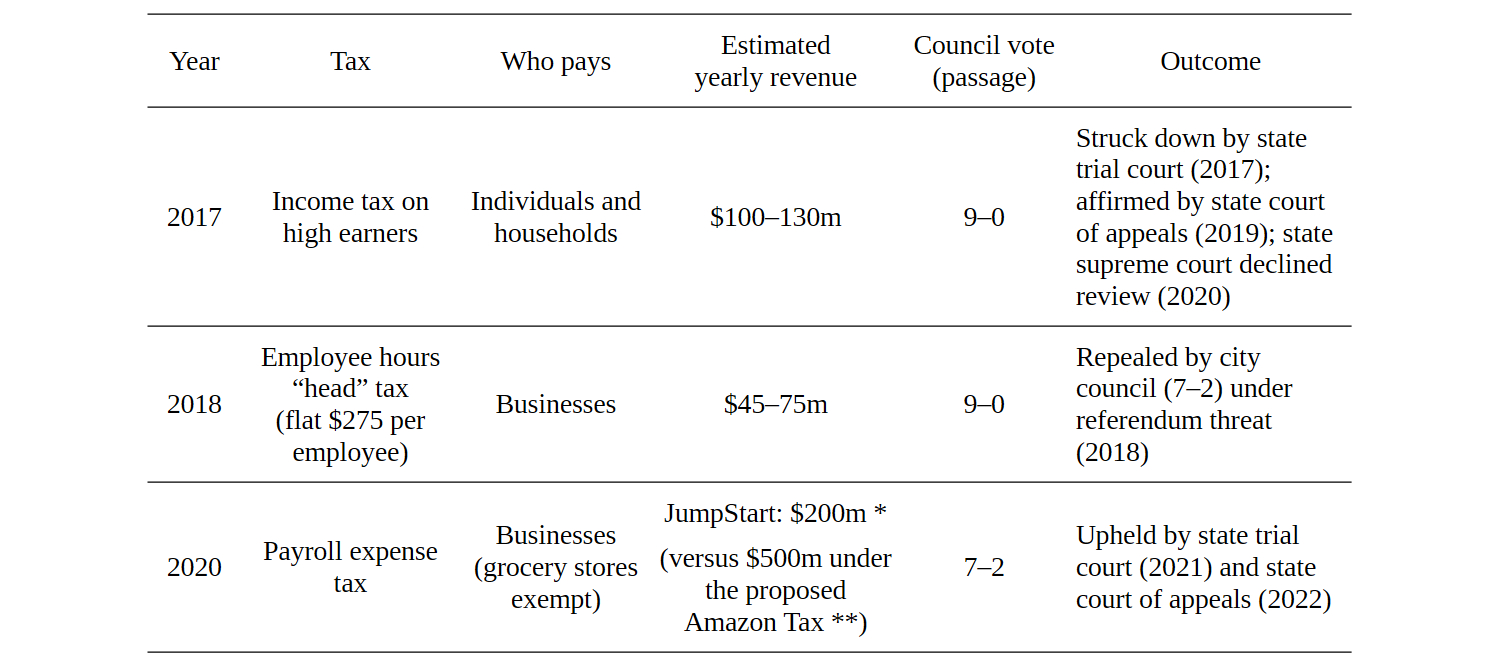
* See: https://clerk.seattle.gov/search/council-bills/119810.
** See: https://clerk.seattle.gov/search/council-bills/119772.
“The fight for a tax on big business never really stopped, following the defeat of the head tax in 2018,” remarked Katie Wilson, then General Secretary of the Transit Riders’ Union. A labor leader who worked on both the 2018 tax and JumpStart two years later explained the shift in strategy: “We are trying to focus on, where are the places where there is a lot of money, and a lot of revenue, and focusing in on those high earners instead of … saying flat rate, you should be paying for all of these jobs.” Even some business and labor figures who had opposed the 2018 tax eventually publicly endorsed JumpStart.
By the summer of 2020, the council had two proposals to consider: the “Amazon Tax,” co-sponsored by Seattle’s only Socialist councilmember, Kshama Sawant, and Councilmember Tammy Morales, and Mosqueda’s JumpStart, which four colleagues co‑sponsored within a week of its introduction. The Amazon Tax aimed higher, projected to raise more than twice as much, but the two shared the same basic design: both taxed payroll expense rather than headcount, and both exempted grocery stores. Grocers had also been among the leading funders of the campaign to repeal the 2018 head tax. On July 6, the council passed JumpStart by a 7–2 vote, including yes votes from Amazon Tax co‑sponsors.
JumpStart: a radical compromise
Unlike the 2017 measure, JumpStart was not struck down by the courts, because it taxed the privilege of doing business, measured by payroll expense. To stay progressive within the state’s legal limits, JumpStart reached only the largest employers with highly paid employees, with tax rates rising with a company’s level of Seattle payroll (at least $7 million annually) and employee compensation (above $150,000). It was, without being called so, akin to an Amazon tax.
That structure was not just a clever legal maneuver; it had profound political implications. “It’s not just about getting the policy right,” one labor leader said of JumpStart’s passage. “You have to also have the people who are willing to advocate for that policy and convince, you know, five councilmembers and a mayor to sign it.” To her, what separated the two proposals was not ambition but the coalitions behind them. Amazon Tax mobilizers included union rank-and-file and socialist activists, but the proposal itself was never officially endorsed by most of Seattle’s labor leadership.
Endorsements for Mosqueda’s JumpStart mainly came from labor organizations, housing and homelessness organizations (including both service providers and housing developers), and immigrant and refugee organizations, many with preexisting relationships with the councilmember. Coalition members described Mosqueda’s ability to convene as one of her chief strengths, calling her someone who could “hold relationships with people of many different values.”
JumpStart’s broad appeal also owed something to a radical flank effect, in which more “radical” actors shape responses to “moderate” ones. Even business actors came to regard JumpStart as the most business-friendly option, because the Amazon Tax, in a phrase its supporters often used, held “the Overton window” (the range of policies considered politically acceptable) open. As a grassroots organizer with ties to both campaigns put it: “JumpStart wouldn’t have looked centrist if you hadn’t had [the Amazon Tax] … It looked like a compromise position when it was still radical.”
Taking effect in 2021, JumpStart raised nearly $300 million, well above projections and equal to nearly a fifth of the city’s general fund.
Redistributive commitments and their afterlives
JumpStart was supposed to allocate the bulk of the revenue (62% of the total, about $135 million annually) to housing. Of that, 82% would finance affordable-housing developers to build, acquire, and operate rental housing for households at or below 60% of area median income, with priority for those at or below 30%. The remainder would fund affordable homeownership, advance fair housing and remedy past discriminatory practices. The next-largest commitment (15%) went to economic revitalization, supporting business recovery and worker retraining. The rest went to community-led equitable development to resist displacement (9%) and Green New Deal investments (9%), with the remaining 5% for administration. In addition to codifying commitments through allocation percentages, the city also created a dedicated fund and an oversight committee.
JumpStart’s afterlives, however, have produced more mixed results. “After the passage of JumpStart is when it gets interesting,” a social-service provider said, describing efforts to protect the revenue’s original redistributive purposes as a “constant battle.” This fight was especially difficult because of efforts by former mayor Bruce Harrell’s office “to claw back those revenues to fill other budget holes, including police budgets.” Transfers to the general fund grew from $86 million in 2022 to $265 million in the 2026 endorsed budget, constituting 52% of total JumpStart funds. Under a fiscal entrepreneurial logic, revenue raised for redistribution became fungible capacity, drifting toward the general-purpose uses that budget pressure rewards.
The city council also dismantled the measures of democratic accountability. In November 2024, they eliminated the oversight committee whose members Mayor Harrell had never appointed and replaced the spending plan’s percentages with looser “guidelines, rather than prescriptive, binding restrictions.” The budget office’s own note on the ordinance acknowledged that the original framework “has never been adhered to.” A year later, a council budget analyst described the change as making JumpStart “fiscally equivalent” to the general fund, one of the city’s “two largest general-purpose funds.” The fund could now cover the legal settlements that the 2020 racial-justice protests had driven up—the same protests that had helped build support for the tax.
Anti-austerity, with an asterisk?
Passage of JumpStart is a momentous accomplishment. Despite deep-seated limits to local power, Seattle enacted an innovative, progressive business tax in one of the most regressive systems in the nation. In a state without income taxes, JumpStart has managed to tap the largest salaries by taxing big employers’ payroll expenses instead. Unlike other Seattle tax reform attempts in the decade leading up to it, JumpStart was neither struck down nor repealed.
But JumpStart’s afterlife offers a more sobering lesson. Building fairness into who paid and how much took years. The fairness promised in how the revenue was spent proved far easier to undo. Once coalition members lost say over its use, and the councilmembers who championed it left the council, the funds were no longer primarily spent on their original purported mission. Mayor Wilson’s first proposed budget shows two persisting pressures: competition with neighboring locales to court businesses, and the pull of JumpStart revenue toward general budget gaps. Her proposal declines to raise JumpStart, citing lower business taxes elsewhere in the metro area. It trims the direct transfer of the tax’s revenue to the general fund, but for the first time temporarily shifts roughly half of the cost of the city’s homelessness response onto JumpStart, while preserving a share for affordable housing. For movement-backed leaders from Seattle to New York, winning a tax on the rich is only the first fight. The harder one is keeping the fiscal capacity it builds in service of redistribution, rather than the status quo.
Bibliography
- Brenner, Neil and Theodore, Nik. 2002. “Cities and the geographies of ‘actually existing neoliberalism’”, Antipode, vol. 34, no. 34, pp. 349–379.
- Hacker, Jacob S. 2004. “Privatizing Risk without Privatizing the Welfare State: The Hidden Politics of Social Policy Retrenchment in the United States”, American Political Science Review, vol. 98, no. 98.
- Joy, Meghan and Vogel, Ronald K. 2021. “Beyond Neoliberalism: A Policy Agenda for a Progressive City”, Urban Affairs Review, vol. 57, no. 57, pp. 1372–1409.
- Martin, Isaac. 2001. “Dawn of the Living Wage: The Diffusion of a Redistributive Municipal Policy”, Urban Affairs Review, vol. 36, no. 36, pp. 470–496.
- Ogorzalek, Thomas K. 2021. “The City Re‑centered? Local Inequality Mitigation in the 21st Century”, in Hacker, Hertel-Fernandez, Pierson and Thelen (eds.), The American Political Economy, 1st ed., Cambridge: Cambridge University Press, pp. 181–208.
- Pacewicz, Josh. 2016a. “The City as a Fiscal Derivative: Financialization, Urban Development, and the Politics of Earmarking”, City & Community, vol. 15, no. 15, pp. 264–288.
- Pacewicz, Josh. 2016b. Partisans and Partners: The Politics of the Post-Keynesian Society, Chicago: University of Chicago Press.
- Peck, Jamie. 2012. “Austerity urbanism: American cities under extreme economy”, City, vol. 16, no. 16, pp. 626–655.
- Scharff, Erin Adele. 2011. “Taxes As Regulatory Tools: An Argument for Expanding New York City’s Taxing Authority”, New York University Law Review, vol. 86, no. 86, pp. 1556–1589.
- Schragger, Richard. 2016. City Power: Urban Governance in a Global Age, 1st ed., Oxford: Oxford University Press.
- Schragger, Richard C. 2021. “Localism All the Way Up: Federalism, State–City Conflict, and the Urban–Rural Divide”, Wisconsin Law Review, pp. 1283–1313. Available online at the following URL: https://papers.ssrn.com/sol3/papers.cfm?abstract_id=3922810.
- Streeck, Wolfgang and Thelen, Kathleen Ann (eds.). 2005. Beyond Continuity: Institutional Change in Advanced Political Economies, Oxford/New York: Oxford University Press.


