

Are channels of public participation in urban planning always mobilised by more privileged social groups? Decades of research in Europe and North America have shown that this is often the case, despite efforts to involve broader publics (Inner and Booher 2004; Brownill and Parker 2010). A new instrument created in England by the 2011 Localism Act opened up the possibility for local residents and businesses to prepare, in a voluntary manner, a “neighbourhood development plan” (NDP). Expectations were high about the potential of this new participatory channel to engage broader sections of society into the planning process. Yet a decade ago, in this journal, Tribillion (2014) analysed the social geography of early neighbourhood planning (NP) initiatives in London and warned that the process risked reinforcing sociospatial inequalities: “distinct homogeneous groups, mostly well-off, can now enact new administrative boundaries around their ‘neighbourhood’, and gain more control over the planning of their environment” (p. 8) (see also Drozdz 2013). This article assesses whether Tribillon’s early concerns have been confirmed, using 2021 census data to update his analysis. It shows that NP activity in London has indeed concentrated in affluent, although often ethnically diverse, areas, but that this has not necessarily led to exclusionary agendas. As the national Labour government elected in 2024 has embarked on a new program of devolution, local government and public-service reforms in England that mobilise the rhetoric of the “neighbourhood”, lessons from the NP experiment matter.
The uneven social geographies of English neighbourhood planning
Under the Localism Act, in rural areas, existing town or parish councils [1] can start an NP process. In urban areas, where such councils typically do not exist, a group of at least 21 residents and businesses have to come together to create a “Neighbourhood Forum,” agree on neighbourhood boundaries, apply to their local authority for designation, and work voluntarily to develop a coherent plan. By March 2024, 3,068 areas in England had been designated for the preparation of a neighbourhood plan under the Act, of which 1,215 got their plan adopted (Locality 2024). NP uptake has predominantly taken place in (comparatively wealthier) rural and semi-rural areas, less so in urban areas (Parker, Wargent et al. 2020). This is first explained by the above-mentioned dual institutional design of NP designation foreseen in the law. In cities characterised by high ethnic, class and socioeconomic diversity, the emergence of such a form of local collective action cannot be taken for granted (Colomb 2017). This makes urban areas a challenging testbed for NP, a process rooted in a rural imaginary of homogeneous, stable, identifiable and self-conscious “local communities” (ibid.). In 2019, out of 2,612 designated NP areas, only 8.5% were Forum-led in cities (Parker, Wargent et al. 2020).
The challenges of creating Neighbourhood Forums have been particularly salient in London, a “super-diverse” and highly unequal metropolis of 9 million inhabitants. Social inequalities are expressed spatially in an intricate, fine-grain juxtaposition of wealth and deprivation at a micro scale (CfC 2023), as social housing exists alongside owner-occupied houses and privately rented, heterogeneous apartment blocks. In 2022, only 26 neighbourhood plans had been approved in London, and 75% of London’s 33 local authorities [2] did not have any such plans (NPL 2022). A crowdsourced mapping project showing the location of NP areas demonstrated their concentration in the wealthier parts of Inner London, with comparatively less activity in Outer London.
Neighbourhood planning in London: a minority sport in privileged areas?
Tribillon (2014) mapped the location of emerging Neighbourhood Forums in London in 2013 against socioeconomic and ethnic diversity indicators, based on 2011 census data. He showed that, first, 72% of Neighbourhood Forums originated in areas where a majority of employed residents worked in high-level managerial occupations, while only 18% came from areas composed primarily of workers in elementary occupations. We updated Tribillon’s exercise in March 2024, using 2021 census data (Denotti and Cooper 2023). A total of 72 designated NP areas were identified, of which 33 had completed plans. Figure 1 confirms the correlation between NP uptake and occupational homogeneity. In all, 85% of Neighbourhood Forums with a completed plan were in areas with high or very high levels of “higher managerial, administrative, and professional occupations”. Only 6.1% (two) were located in areas with a majority of “elementary occupations”. For Neighbourhood Forums that had not yet completed their plan, 74% were in areas with high or very high levels of top-tier managerial occupations.
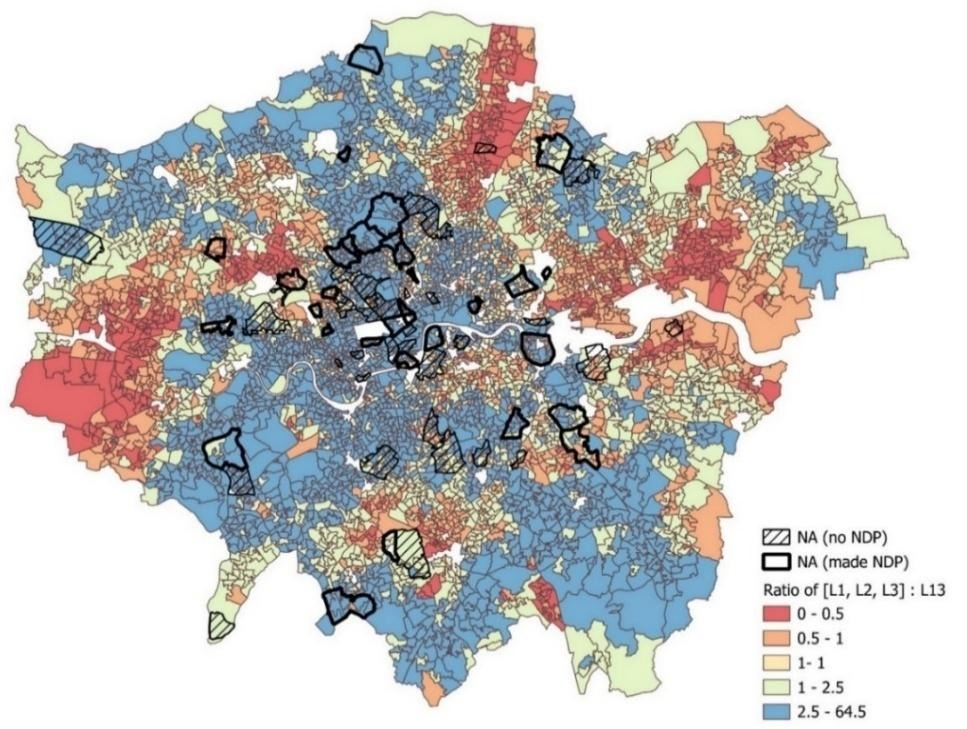
The results of a decade of research on NP in England offer us explanations about this pattern of concentration. Scholars have shown that NP volunteers tend to be wealthier, highly educated, older homeowners, often active in existing local civic groups (Brookfield 2017; Colomb 2017; Parker et al. 2023). The preparation of a neighbourhood plan requires considerable resources, legal and planning knowledge, and volunteers’ time—two to five years (Parker, Dobson et al. 2020; Parker et al. 2023). There are thus significant differences in the “civic capacity” of people to engage in NP (Gunn et al. 2015; Sturzaker and Shaw 2015; Wills 2016). For many, the costs of participation may outweigh expected benefits (Holman and Rydin 2013; Mace and Tewdwr-Jones 2017). All this explains the social composition effects behind the uneven geography of NP activities between regions, and within metropolitan areas like London.
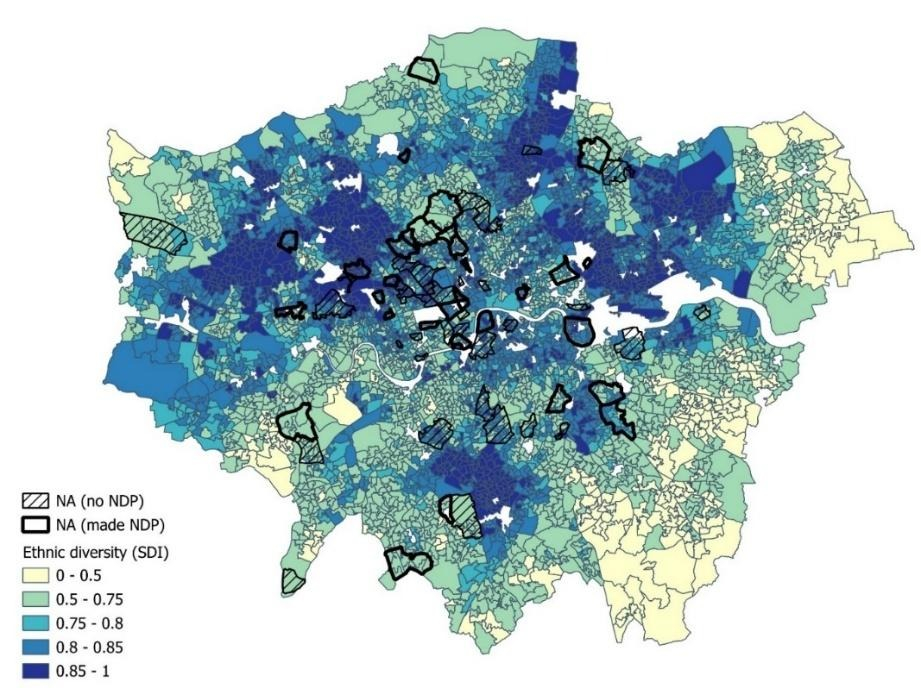
By contrast, Tribillon (2014) showed that there was a weak correlation between the location of early Neighbourhood Forums and the level of ethnic diversity of an area in London (measured through Simpson’s Diversity Index, SDI). Our update showed a similar picture. Only 30% of Neighbourhood Forums with a completed plan and 23% of Neighbourhood Forums with no plan yet were in areas with a SDI lower than the London average. The majority (70.8%) were in regions with an SDI higher than the London average (Figure 2), although only 29% were in the most ethnically diverse areas (in dark blue). Possible explanations for those observations would need to be investigated further. Areas with a high SDI are composed of different mixes of ethnic groups with different income and occupational levels. For example, the recorded ethnic mix of a borough like Westminster, which has a lot of NP activity, is considered significant, but it includes a high proportion of “other White” groups in top-tier income and professional categories.
A civic mobilisation with limited effects?
Our update confirms Tribillon’s early findings that the uptake of NP has been concentrated in comparatively wealthier areas, mostly in Inner London (see also Apostolides 2018), though often containing an ethnically mixed population. However, Tribillon’s conclusion that the NP process would give well-off groups “more control over the planning of their environment” (2014, p. 8), possibly with exclusionary agendas, should be nuanced by three caveats. First, in many parts of London, there has been no NP activity. The significant time and resources required deter many from engaging in the process; while in some areas, attempts at starting the process have failed, owing to social conflicts (for example, in Hackney (Colomb 2017); see also NPL and Publica 2019; London Assembly 2020). Second, the influence of an NP on the planning decision-making process is, by design, relatively limited: its content must be in line with the existing Local Plan (i.e. the municipal land-use plan) that shapes the parameters of development. Third, while there were early concerns that NP initiatives led by wealthy homeowners would be driven by a protectionist agenda (Sturzaker and Shaw 2015), evidence has not supported this. Many NPs have allocated more housing units than required by the Local Plan (Parker, Wargent et al. 2020; Salter et al. 2022), often advocating for small-scale affordable housing (Bradley and Sparling 2017). In London, NP volunteers in some affluent areas such as Highgate have advocated for more affordable housing, “out of political belief, pragmatic necessity or search for consensus around the future of a ‘place’ which they care about” (Colomb 2017, p. 140). In comparatively less-wealthy areas, middle-class “gentrifiers” have often got involved in processes of “place making and place maintenance” (Jackson and Benson 2013) such as NP, sometimes campaigning with long-standing residents to protect a fragile socio-functional mix (Colomb 2017), despite clear difficulties in mobilising a broad range of voices (Apostolides 2018; NPL and Publica 2019).
Conclusions
The socially uneven geography of NP uptake in London, and in England more broadly, shows that this innovative instrument has not significantly democratised public participation in planning overall, despite local successes. As formulated by Dobson and Parker, NP is “de facto available to the most able citizens, despite being presented and consistently deployed by government as a de jure right available to all” (2025, p. 491). Why does this matter? The national Labour government elected in 2024 has sent ambiguous, contradictory signs about the importance of the neighbourhood scale, and of local public engagement, in public policies.
On the one hand, in the face of an acute housing crisis, the government has launched a reform of the planning system to speed up new development. The revised National Planning Policy Framework makes it clear that NP should not undermine the local housebuilding targets set by central government. NP is technically maintained, but in 2025 the housing ministry announced the end of the funding scheme that supported groups preparing an NP: this will jeopardise the preparation of new plans and affect poorer areas with less “civic capacity” (Blackman 2025). On the other hand, the Labour government has announced an ambitious programme of devolution, local-government reform, and “neighbourhood working” in public services in England (Parker et al. 2025; LGiU 2026). The 2026 English Devolution and Community Empowerment Bill requires local councils to establish a new “neighbourhood governance structure”, the details of which have not yet been set out. In parallel, a new neighbourhood regeneration programme, Pride in Place, has earmarked £5 billion over 10 years for the most deprived areas in England, to be managed through new “Neighbourhood Boards”. Those recent announcements do not refer to the cumulative experience of NP, whose most powerful lesson is that civic capacity is unevenly distributed. As the words of late planning theorist Patsy Healey (2015) remind us, “enhancing the capacity of local political communities concerned with the qualities of the places of value to them to develop more locally relevant strategies, programmes and projects is an important ambition”. But in localities marked by rising socioeconomic inequalities, there will be no “progressive localism” without reversing years of funding cuts to local government, to the local voluntary sector, and to the social infrastructure that underpins the activation of civic capacity at the neighbourhood level.
Bibliography
- Apostolides, K. 2018. “Neighbourhood planning in London: fulfilling the coalition’s stated objectives? An exploration of the representativeness and inclusiveness of neighbourhood forums”, Town Planning Review, vol. 89, no. 3, pp. 229–58. Available online at the following URL: www.liverpooluniversitypress.co.uk/doi/10.3828/tpr.2018.15.
- Blackman, D. 2025. “How the axing of government funding threatens to stop most neighbourhood plans in their tracks”, Planning Resource, 31 July. Available online at the following URL: www.planningresource.co.uk/article/1927509/axing-government-funding-threatens-stop-neighbourhood-plans-tracks.
- Bradley, Q. and Sparling, W. 2017. “The Impact of Neighbourhood Planning and Localism on House-building in England”, Housing, Theory and Society, vol. 34, no. 1, pp. 106–118. Available online at the following URL: www.tandfonline.com/doi/full/10.1080/14036096.2016.1197852.
- Brookfield, K. 2017. “Getting involved in plan-making: Participation in neighbourhood planning in England”, Environment and Planning C: Politics and Space, vol. 35, no. 3, pp. 397–416. Available online at the following URL: https://journals.sagepub.com/doi/10.1177/0263774X16664518.
- Brownill, S. and Parker, G. 2010. “Why Bother with Good Works? The Relevance of Public Participation(s) in Planning in a Post-collaborative Era”, Planning Practice and Research, vol. 25, no. 3, pp. 275–282. Available online at the following URL: www.tandfonline.com/doi/abs/10.1080/02697459.2010.503407.
- Centre for Cities (CfC). 2023. “Three things neighbourhood-level data can tell us about the geography of household incomes in English cities”, Centre for Cities [blog], 14 December. Available online at the following URL: www.centreforcities.org/blog/geography-of-household-incomes-in-english-cities.
- Colomb, C. 2017. “Participation and conflict in the formation of neighbourhood areas and forums in ‘super-diverse’ cities”, in S. Brownill and Q. Bradley (eds.), Localism and Neighbourhood Planning, Bristol: Bristol University Press, pp. 127–144.
- Denotti, A. and Cooper, I. 2023. “Census 2021: How ethnically diverse are our boroughs?”, Impact on Urban Health, 1 May. Available online at the following URL: https://urbanhealth.org.uk/insights/data/census-2021-how-ethnically-diverse-are-our-boroughs.
- Dobson, M. and Parker, G. 2025. “The moral economy of localism in England: neighbourhood planning as neoliberal ‘apprentice piece’”, Territory, Politics, Governance, vol. 13, no. 4, pp. 488–504. Available online at the following URL: www.tandfonline.com/doi/full/10.1080/21622671.2023.2184856.
- Drozdz, M. 2013. “Will local-government reform in London involve or abandon its citizens?”, Metropolitics, 3 July. URL: https://metropolitics.org/Will-local-government-reform-in.html.
- Gunn, S., Brooks, E. and Vigar, G. 2015. “The community’s capacity to plan: the disproportionate requirements of the new English neighbourhood planning initiative”, in S. Davoudi and A. Madanipour (eds.), Reconsidering Localism, Abingdon/New York: Routledge, pp. 147–167.
- Healey, P. 2025. “Civic capacity, place governance and progressive localism”, in S. Davoudi and A. Madanipour (eds.), Reconsidering Localism, Abingdon/New York: Routledge, pp. 105–125.
- Holman, N. and Rydin, Y. 2013. “What Can Social Capital Tell Us About Planning Under Localism?”, Local Government Studies, vol. 39, no. 1, pp. 71–88. Available online at the following URL: www.tandfonline.com/doi/full/10.1080/03003930.2012.675330.
- Innes, J. E. and Booher, D. E. 2004. “Reframing public participation: strategies for the 21st century”, Planning Theory & Practice, vol. 5, no. 4, pp. 419–436. Available online at the following URL: www.tandfonline.com/doi/abs/10.1080/1464935042000293170.
- Jackson, E. and Benson, M. 2013. “Place-making and Place Maintenance: Performativity, Place and Belonging among the Middle Classes”, Sociology, vol. 47, no. 4, pp. 793–809. Available online at the following URL: https://journals.sagepub.com/doi/10.1177/0038038512454350.
- LGiU. 2026. “Why we need to focus on the ‘How’ of Neighbourhood Working: Launching our new research programme”, LGiU [website], 16 May. Available online at the following URL: https://lgiu.org/why-we-need-to-focus-on-the-how-of-neighbourhood-working-launching-our-new-research-programme.
- Locality. 2024. “Key neighbourhood planning data”, Neighbourhood Planning [website] (last updated 22 March 2024). Available online at the following URL: https://neighbourhoodplanning.org/toolkits-and-guidance/key-neighbourhood-planning-data.
- London Assembly. 2020. Neighbourhood planning – progress and insights. Available online at the following URL: www.london.gov.uk/sites/default/files/neighbourhood_planning_report_-_final.pdf.
- Mace, A. and Tewdwr-Jones, M. 2017. “Neighbourhood Planning, Participation and Rational Choice”, Journal of Planning Education and Research, vol. 39, no. 2, pp. 184–193. Available online at the following URL: https://journals.sagepub.com/doi/abs/10.1177/0739456X17727334.
- Neighbourhood Planners.London (NPL) and Publica. 2019. “Neighbourhood Planning in London: Investigating its potential in areas experiencing high levels of deprivation”, Trust for London. Available online at the following URL: https://trustforlondon.org.uk/research/neighbourhood-planning-london-investigating-potential-areas-experiencing-high-levels-deprivation.
- Neighbourhood Planners.London (NPL). 2022. State of neighbourhood planning in London – 2022, report, June. Available online at the following URL: www.neighbourhoodplanners.london/_files/ugd/95f6a3_c4845aed02ea4fb3b11919a81a17a797.pdf.
- Parker, G., Dobson, M., Lynn, T. and Salter, K. 2020. “Entangling voluntarism, leisure time and political work: the governmentalities of Neighbourhood Planning in England”, Leisure Studies, vol. 39, no. 5, pp. 1–15. Available online at the following URL: www.tandfonline.com/doi/abs/10.1080/02614367.2020.1763440.
- Parker, G., Wargent, M., Salter, K., Dobson, M., Lynn, T. and Yuille, A. 2020. Impacts of Neighbourhood Planning in England, final report to the Ministry of Housing, Communities and Local Government, May. Available online at the following URL: https://assets.publishing.service.gov.uk/media/5f96b99de90e077b087c33db/Impacts_of_Neighbourhood_Planning_in_England.pdf.
- Parker, G., Wargent, M., Salter, K. and Yuille, A. 2023. “Neighbourhood planning in England: A decade of institutional learning”, Progress in Planning, vol. 174, art. 100749, 11 March. Available online at the following URL: www.sciencedirect.com/science/article/pii/S0305900623000107.
- Parker, G., Wargent, M., Sturzaker, J. and Lynn, T. 2025. “Learning old lessons can improve delivery of the government’s new Plan for Neighbourhoods”, The Planner, 10 April. Available online at the following URL: www.theplanner.co.uk/2025/04/10/learning-old-lessons-can-benefit-governments-new-plan-neighbourhoods.
- Salter, K., Parker, G. and Wargent, M. 2022. “Localism and the will to housing: neighbourhood development plans and their role in local housing site delivery in England”, Planning Practice and Research, vol. 38, no. 2, pp. 253–273. Available online at the following URL: www.tandfonline.com/doi/full/10.1080/02697459.2022.2145032.
- Sturzaker, J. and Shaw, D. 2015. “Localism in practice: lessons from a pioneer neighbourhood plan in England”, Town Planning Review, vol. 86, no. 5, pp. 587–609. Available online at the following URL: www.liverpooluniversitypress.co.uk/doi/10.3828/tpr.2015.34.
- Tribillon, J. 2014. “The Localism Act in London: institutionalising urban divisions”, Metropolitics. 16 April. URL: https://metropolitics.org/The-Localism-Act-in-London.html.
- Wills, J. 2016. “Emerging geographies of English localism: The case of neighbourhood planning”, Political Geography, vol. 53, pp. 43–53. Available online at the following URL: www.sciencedirect.com/science/article/abs/pii/S0962629816000251.


