


In Beirut, an apparently contradictory form of affordable housing has taken root in the wake of decades of Israeli aggression, civil and regional wars, and the successive disruption of previous patterns of ownership and occupation through forced displacement. On one hand, affordable housing is now mainly driven by the informal repurposing of deteriorated structures from long-term to short-term, low-cost uses. Here, affordable housing production based on converting tenure exhibits many features of a market-led activity—such as speculation, risks, and tenant insecurity. On the other hand, a comprehensive analysis of the ownership and the tenure structure of this affordable housing reveals a recurring configuration in which the owner remains systematically divested from the property, while the activity is initiated and operated by a figure designated here as a “rent intermediary.” The essential ceding of the use of the land by an owner to the rent intermediary enables the latter to realize a profit, while acting as a form of subsidized land access typically seen in social housing initiatives. Beirut’s affordable housing is therefore a compelling case study for land and housing research to deepen our comprehension of the diverse factors influencing housing affordability.
This article starts by elucidating the tenure conversion process. This process is contrasted, in the second section, with the analysis of the legal and political dynamics of ownership in private property, and then, in the third section, with public property. The article concludes with an outline of lessons for social housing policy in Lebanon. Analysis draws on qualitative data gathered from field observations and interviews with market agents and users in parallel to consulting the land registry archive.
Informal tenure conversion
The conversion of tenure into short-term, low-cost housing in Beirut intensified during the post–civil war reconstruction period, responding to demand from low-wage construction and service workers needing accommodation (Marot 2018; LCHR/CLDH 2013). In addition, the demand for low-cost housing became more acute following the Iraqi (2003) and Syrian (2011) wars, which produced massive refugee inflows, largely absorbed into the regular and irregular urban fabric (Fawaz 2016).
Within Beirut’s municipal boundaries, this practice emerged in middle- and low-income areas in relative decline. It originally occurred in depreciated structures—previously occupied, abandoned, or vacated—where rent intermediaries undertook minimal repairs prior to leasing units, either on a per-bed basis to workers or as studios for displaced families, subdividing apartments into multiple units.
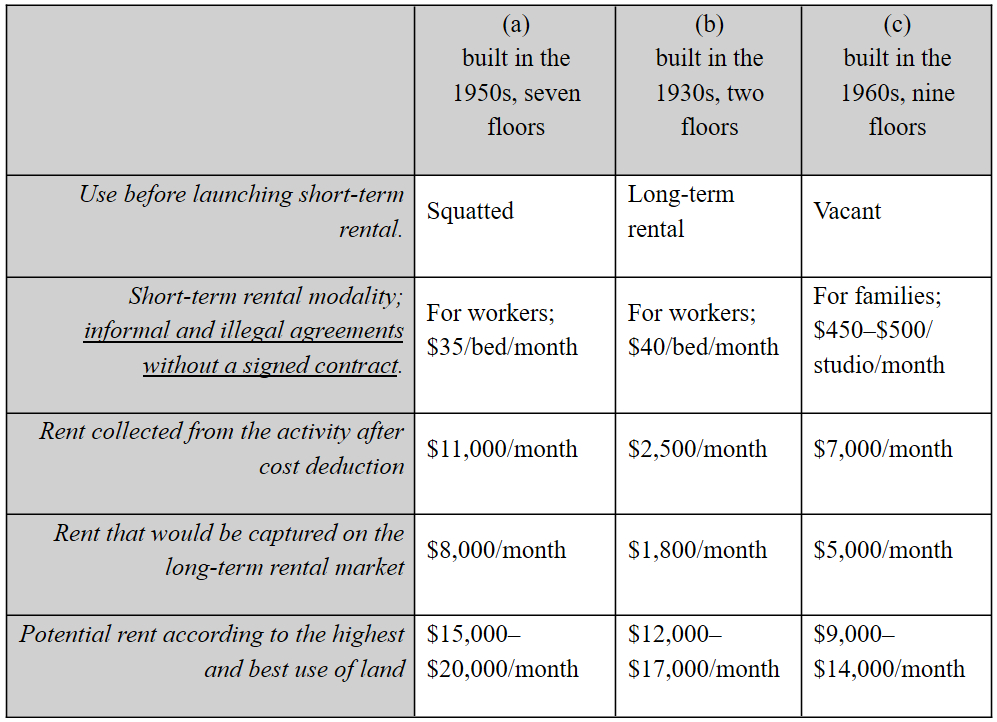
The rental agreement that emerges from this tenure conversion is only verbal. This exposes tenants to high levels of insecurity, obliging them to vacate premises upon demand and endure substandard living conditions. For rent intermediaries, however, it is profitable. Table 1 illustrates these profits and provides a comparative advantage over alternative uses. Case (a) concerns a 14-apartment, seven-story building, offering beds to male workers at $35 per month—a highly accessible rate. Despite the low rent, the rent intermediary realizes a net profit of $11,000 after costs. By contrast, renting the same deteriorated building as long-term apartments would yield no more than $8,000 per month, and only after costly rehabilitation. Redevelopment of the land in line with current urban regulations could generate $15,000–$22,000 per month. Thus, the short-term affordable housing model is competitive, given its minimal upfront investment.
Yet the rationale of this market cannot be fully grasped without examining the owner’s relationship with the rent intermediary, characterized by the former’s disinvestment, whether in private or public property, and the latter’s initiative to increase profit from land use.
Disinvested private property
Disinvested private property on a neighborhood scale is rooted in the social and economic repercussions of the civil war. It is observed in particular, but not exclusively, in pericentral neighborhoods, once known as the Beirut Medina Faubourgs, formerly inhabited by the Beiruti bourgeoisie, and whose urban fabric underwent significant transformations during the civil war (Davie 1996; Kassir 2010). Analyzing the owners’ disinvestment elucidates the political or economic factors shaping the current de facto housing policy.
Politically, some heirs of owner-occupiers come from the bourgeoisie that had once invested and lived in the pericentral faubourgs. After being displaced, some of these owners—especially those who subscribe politically to a segregated vision and practice of the city based on political identity—refuse to come back to neighborhoods they perceive as socially and politically antagonistic; this is a perception rooted in wartime spatial transformations and segregation. These attitudes are most pronounced in the now-poor pericentral faubourgs (Brones 2020). The withdrawal of these bourgeois owners reflects how urban stigma unfolds in the form of disinvestment shaped less by material conditions and profit calculation than by refusing to engage as long as people with a certain political and social identity are present in their once-upper-class neighborhood.
In addition, impoverished owners who are now unable to finance rehabilitation and lacking institutional support, such as access to credit, find themselves at an economic impasse. In both cases, these deteriorated properties, unsuited for long-term rental, are no longer treated as fixed capital generating returns but as burdens tied to taxes and the risk of squatting.
These private ownership configurations converged with rising demand for low-cost housing, allowing rent intermediaries—often local residents of the district—to lease buildings from owners. Rent intermediaries formalized contracts with owners, in contrast to their verbal agreements with tenants (workers or refugees). These agreements tend to set a minimum threshold—enough to cover taxes and secure agreement—as owners aim to avoid vacancy and squatting, and neither expect nor could hope to obtain market-rate returns on longer-term rentals. Thereafter, owners grant the rent intermediaries full discretion over property use and pricing.
Disinvested public property
Disinvested public property reflects the inertia of the public administration in implementing and executing public infrastructure. In Beirut, large inhabited areas were placed under prolonged expropriation orders for inner ring-road projects (Lamy and Ibrahim 2014). Initiated in the 1970s, procedures were completed only in the 2010s, and then on only a fraction of the expropriated land reserves. Administrative inertia during and after the war signaled the public administration’s disinvestment in these properties, while legal bans on construction and rehabilitation accelerated deterioration. Some expropriated owners accepted compensation and vacated; others resisted. Though legally public, these lands remain socially contested through de facto uses that block projects and delay evacuation.
Amid deterioration and incentives for low-cost, short-term rental conversion, de facto owners and tenants repurposed expropriated properties. A notable feature is that these de facto owners are not just the original, expropriated owners; users of the space at the time of expropriation are also acting as rent intermediaries in this affordable-housing market. For example, case (b) in Table 1 above refers to public land expropriated in 1972 on which stands a two-story building. At the time of expropriation, the building was rented out to two cousin families. Despite the expropriation, they remained in the building, acting as claimants on its use until purchasing in the suburbs in the 1990s and moving there. Nonetheless, they remained the de facto rights claimants on the use of the building and decided to rent it out on the affordable-housing market after subdividing each apartment into two, which has, in turn, funded part of their credit arrangements to access property in the suburbs.
Access to public land is more beneficial to these de facto owners than affordable housing on disinvested private property, as no ground rent is owed to public administration; this market is restricted to expropriated land. However, the long periods of public ownership and inaction during which any physical intervention was prohibited have constrained the housing stock to low-capacity structures. This is in contrast to the substantial inventory found in divested private properties, which features taller buildings that attract rent intermediaries.
Conclusion
This article argues that informal spatial practices may be shaped less by active informal interventions than by the formal retreat, or disinvestment, of actors from land as a resource. It pushes us to rethink the link between informality and affordability, especially in the context of a weak welfare state. In the case of informal affordable housing in Beirut, affordability derives mainly from the dissociation between the economic value of land from that of the built structure. This dissociation constitutes the foundation of many, if not most, social and public affordable-housing policies and should be safeguarded in any future policy framework in Lebanon.
However, the sustainability of this affordable provision remains fragile, owing to the relative and reversible nature of both public and private owners’ disinvestment. On the one hand, market pressures for land development and upgrading may outbid what rent intermediaries in the affordable housing market currently offer to divested private owners. On the other hand, public authorities may reactivate planned infrastructure projects, such as inner ring-road developments, leading to tenant displacement through the enforced evacuation of affordable uses, including short-term, low-cost rental markets.
The central challenge, therefore, lies in mitigating these risks while identifying the key characteristics of this housing market that should inform any future public intervention aimed at preserving the social value of housing provision within this land portfolio, which includes both public and private properties.
Postscript (September 2026)
The current destruction and mass displacement in Lebanon is placing renewed pressure not only on the low-cost housing stock examined in this article but on the housing sector more broadly, with 21% of the country’s housing stock reportedly destroyed. The resulting surge in demand is intensifying and transforming these informal tenure conversions: previously concentrated in cities and associated mainly with foreign refugees and migrant workers, this form of housing provision is now expanding beyond urban areas, including into long-vacant houses in villages, to accommodate internally displaced households. Yet, as a market-driven provision, and under surging demand, its expansion is shifting it from an affordable, albeit lucrative, activity toward a more extractive one, in which displacement itself becomes a source of rent, echoing dynamics observed during previous episodes of war-induced displacement in the country. This unfolding crisis thus exposes both the adaptability and the fragility of this de facto affordable housing model.
Bibliography
- Baumann, Hannes. 2016. Citizen Hariri: Lebanon’s Neoliberal Reconstruction, London: Hurst & Company.
- Brones, Sophie. 2020. Beyrouth dans ses ruines, Marseille: Éditions Parenthèses/Aix-en-Provence: Maison Méditerranéenne des Sciences Humaines et Sociales (MMSH), “Parcours méditerranéens” collection, “Territoires, Traces et Tracés” series.
- Corm, Georges. 1993. “La Reconstruction du centre de Beyrouth : un exemple de fièvre immobilière au Moyen-Orient”, Revue d’économie Financière, pp. 323–335. Available online at the following URL: www.jstor.org/stable/42903083.
- Davie, May. 1996. Beyrouth et ses faubourgs (1840-1940) : une intégration inachevée, Beirut: Presses de l’Institut Français du Proche-Orient (Ifpo), “Les Cahiers du CERMOC” series, vol. 15.
- Fawaz, Mona. 2016. “Unsettling the ‘Refugee Crisis’: Notes from Beirut”, International Journal of Urban and Regional Research. Available online at the following URL: www.ijurr.org/spotlight-on/the-urban-refugee-crisis-reflections-on-cities-citizenship-and-the-displaced/unsettling-the-refugee-crisis-notes-from-beirut.
- Hourani, Najib. 2012. “From National Utopia to Elite Enclave: ‘Economic Realities’ and Resistance in the Reconstruction of Beirut”, in M. Peterson and G. McDonogh (eds.), Global Downtowns, Philadelphia: University of Pennsylvania Press, pp. 136–159.
- Kassir, Samir. 2010. Beirut, Berkeley: University of California Press.
- Khalaf, Samir, Philip Shukry Khoury and Richard Sennett. 1993. Recovering Beirut: Urban Design and Post-War Reconstruction, Leiden: Brill, “Social, Economic and Political Studies of the Middle East and Asia” series, vol. 47.
- Lamy, Sebastien and Samy Ibrahim. 2014. Recueil des textes relatifs au droit de l’urbanisme et de la construction au Liban. Beirut: Majal.
- Lebanese Center for Human Rights (LCHR/CLDH). 2013. Syrian Workers in Lebanon. Available online at the following URL: www.cldh-lebanon.org/HumanRightsBrie/Report_Syrian_Workers__ENG_final_(2).pdf.
- Marot, Bruno. 2018. “Growth Politics from the Top Down”, City, vol. 22, no. 3, pp. 324–340. DOI: 10.1080/13604813.2018.1484640.
- Nasr, Salim. 1990. “Anatomie d’un système de guerre interne : le cas du Liban”, Cultures & Conflits, no. 01 (winter). DOI: 10.4000/conflits.80.
- Nasr, Salim. 1985. “La transition des chiites vers Beyrouth : mutations sociales et mobilisation communautaire à la veille de 1975”, in M. Zakaria and B. Chbarou (eds.), Mouvements communautaires et espaces urbains au Machreq, Beirut: Presses de l’Institut Français du Proche-Orient (Ifpo), “Contemporain publications” series, vol. 10, pp. 87–116. DOI: 10.4000/books.ifpo.3401.
- Slater, Tom. 2017. “Planetary Rent Gaps”, Antipode: A Radical Journal of Geography, vol. 49, no. S1, pp. 114–137. DOI: 10.1111/anti.12185.
- Slater, Tom. 2018. “The Invention of the ‘Sink Estate’: Consequential Categorisation and the UK Housing Crisis”, The Sociological Review, vol. 66, no. 4, pp. 877–897. DOI: 10.1177/0038026118777451.
- Slater, Tom. 2021. Shaking Up the City, Berkeley: University of California Press.
- Traboulsi, Fawwaz. 2012. A History of Modern Lebanon, chap. 13: “The War Order (1983–1990)”, London: Pluto Press. Available online at the following URL: www.jstor.org/stable/j.ctt183p4f5.19.
- Verdeil, Éric. 2002. “Entre guerre et reconstruction : remblais et empiétements littoraux à Beyrout”, in N. Baron-Yellès, L. Goeldner-Gianella et S. Velut, Le Littoral : regards, pratiques et savoirs. Études offertes à Fernand Verger, Paris: Éditions Rue d’Ulm, pp. 319–335.
- Wehbe, Rouba. 2014. Les Inégalités et la stigmatisation urbaine : le cas de Khandaq el Ghamiq, Beyrouth, master’s thesis, Beirut: Institut d’Urbanisme de l’Académie Libanaise des Beaux-Arts (ALBA).
- Whiting, Rebecca. 2012. “Beirut Digital District: High-Tech Development or Gentrification?”, Al Akhbar English, 28 December.
- Yahya, Maha. 1993. “Reconstituting Space: The Aberration of the Urban in Beirut”, in S. Khalaf and P. Khoury (eds.), Recovering Beirut: Urban Design and Post-War Reconstruction, Leiden: Brill.


