


This original book sheds light on a forgotten—even ignored—object: postcards showcasing France’s postwar social housing projects, or “grands ensembles”. In this book, political scientist Renaud Epstein presents a sample of a collection of some 3,000 postcards (some in mint condition, others used) that he has amassed over the last three decades in the course of his research into urban renewal policies in France; he also published one postcard per day on a Twitter thread [1] titled “Un jour, une ZUP, [2] une carte postale” (“Every day, a housing project, a postcard”). In this book, a total of 76 postcards are reproduced, categorized by region to form a sort of “Tour de France” of social housing projects. These are juxtaposed with short texts of various kinds: excerpts from novels or film dialogues, songs, newspaper articles, and quotes from researchers on these housing complexes. Most notable are the handful of excerpts—photographed and transcribed—from text written on the back of certain postcards. An introduction contextualizes the history of France’s grands ensembles and the successive iconographic representations in which they have featured, principally state-sponsored but also drawn from popular culture. The book is a pleasure to read and offers a fresh perspective on the historical, scientific, and media phenomenon that is the grand ensemble, drawing on a unique source: the postcard.
Photographing housing projects, from the Cité Radieuse to 20th‑century heritage
This book builds on previous research analyzing photographic and cinematic representations of grands ensembles, most of which were constructed in the 1950s and 1960s (see, in particular: Gauthey 1997; Mouchel and Voldman 2011; Canteux 2014). Raphaële Bertho (2014) demonstrated that the public production of housing, primarily driven by the French Ministry of Reconstruction and later the Ministry of Public Works, served to advance a narrative of a modernizing state, within a context of massive housing construction. This narrative was succeeded by one focused on the physical and social decline experienced by a large portion of these housing complexes over the following decades. Then, at the turn of the 21st century, as urban renewal was launched with major demolition programs, a significant portion of these postwar housing projects received official recognition as “20th‑century heritage,” and the French national General Heritage Inventory was tasked with documenting them. The process of designating these housing complexes as heritage sites and their symbolic rehabilitation focused on preserving buildings that were partly at risk, even as the image of social-housing neighborhoods remained negative in the public eye, especially among those who did not live there. Renaud Epstein began his postcard collection during this period. The aim of his book is to showcase the diversity of these housing projects, and capture the social life of their residents in order to destigmatize them.
Showcasing the diversity of postwar housing projects
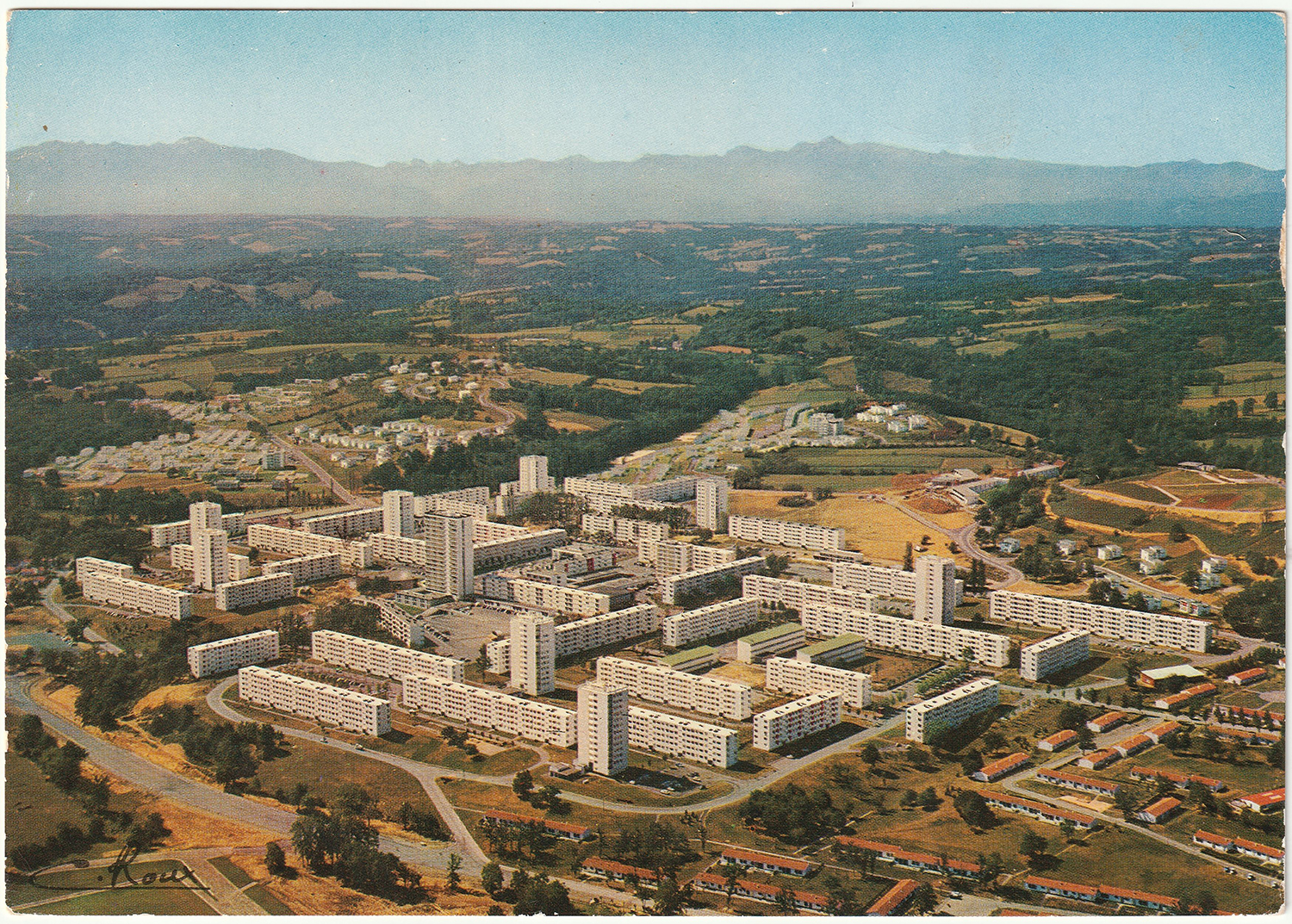
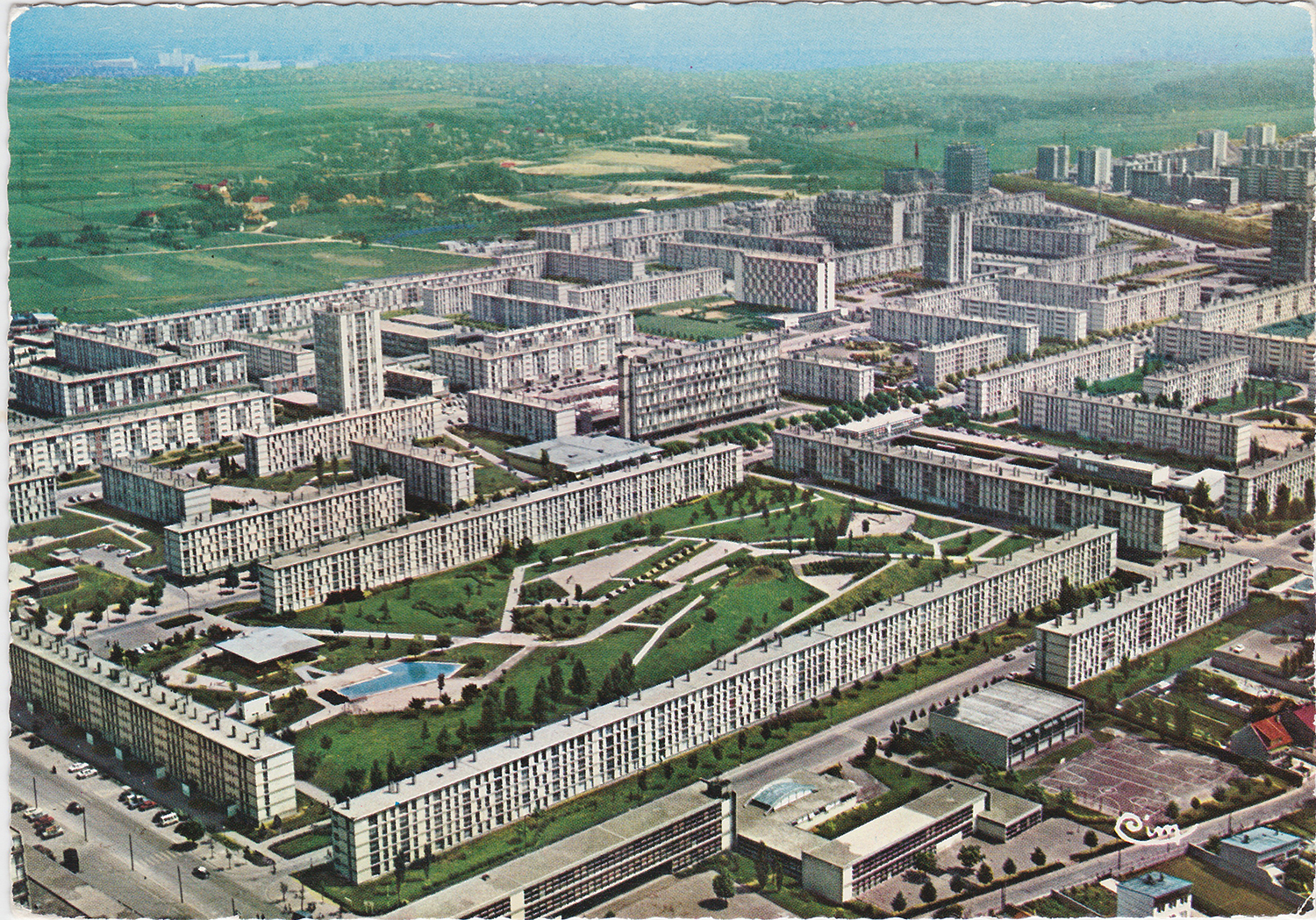
These postcards of grands ensembles convey the official narrative by presenting a stereotypical view of architectural modernization, owing to the photographic conventions employed. Specifically, they mostly feature aerial views, a technique adopted by postcard publishers from the 1950s onward. These images fall into two categories: oblique overviews taken from medium altitude, emphasizing the geometric composition and monumental scale, and low-altitude views that detail buildings, facilities, and sometimes their uses (Pousin 2012, pp. 210–211) (Figures 1 and 2). In this way, the selection of postcards presented in the book demonstrates the coherence of the architectural projects of the modern functionalist movement, while also highlighting the great diversity of sites and complexes—often designed by renowned architects—that are, in fact, distinct for each individual project.
© Collection Renaud Epstein.
© Collection Renaud Epstein.
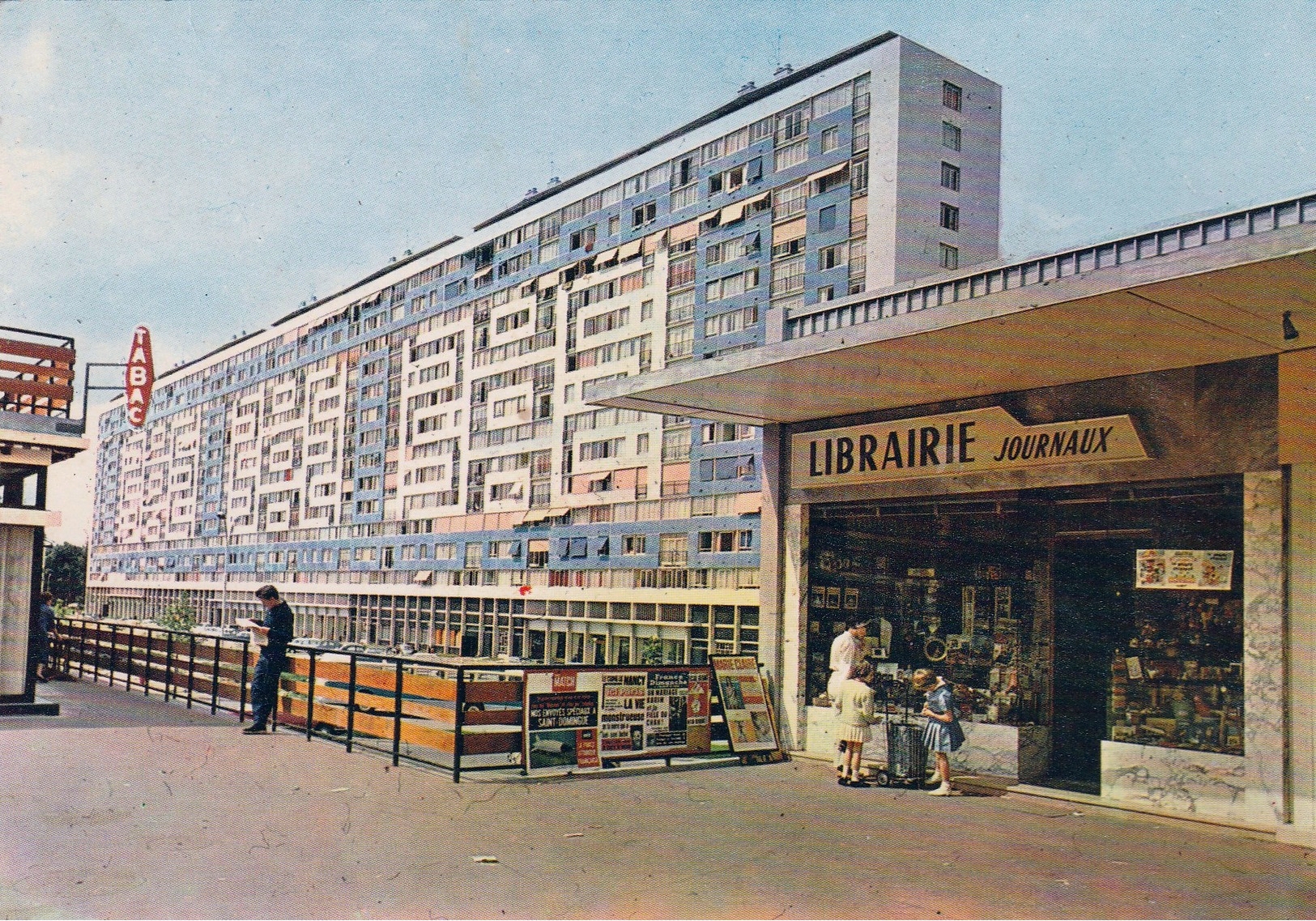
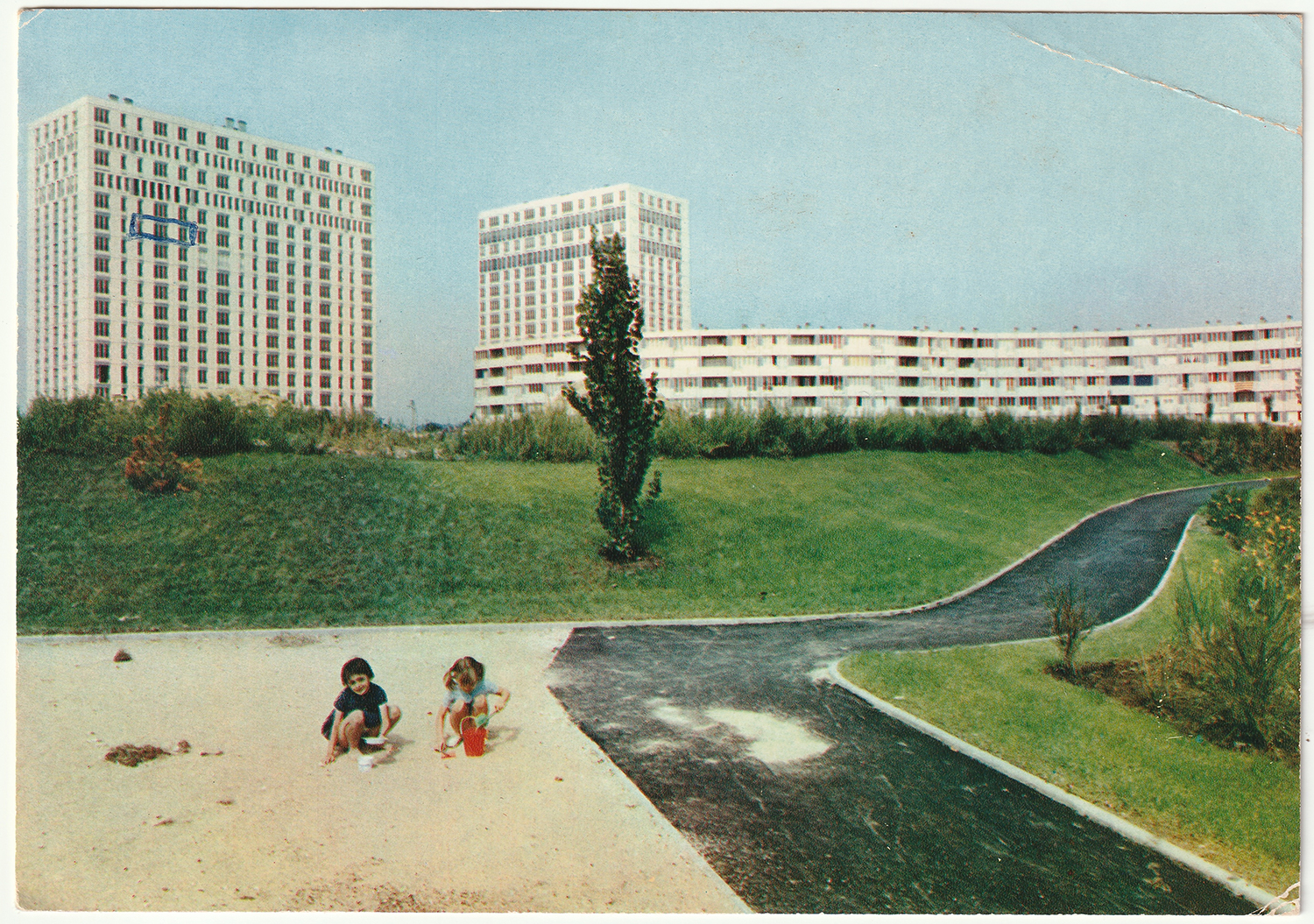
The book echoes the artistic approach of Mathieu Pernot (2007), who reproduced 60 postcards and their handwritten notes on the back in his series “Le meilleur des mondes.” But while Pernot’s series consists mainly of aerial views or wide shots—without dates or locations—conveying a sense of uniform monumentality, Epstein’s selection makes greater use of close-ups, taken from the tops of buildings or at eye level, showing facilities (tobacco shops, swimming pools, lakes, playgrounds) that reveal a variety of situations and uses (Figures 3, 4, and 5). Epstein explicitly distinguishes himself from Pernot’s series (p. 15) by emphasizing that the latter features only black-and-white maps that were colorized during printing, and that this “retro-futuristic choice” conveys an “idyllic yet frightening vision of modernity,” particularly when this series is juxtaposed with the “Implosion” series depicting building demolitions in black and white. According to him, this serves to condense the official narrative. In his book, Epstein selected postcards spanning a slightly longer period; [3] These include both colorized and full-color cards (and a few in black and white) or cards showing multiple views on a single card, which adds nuance to the apparent uniformity of the complexes. To borrow categories outlined by Frédéric Pousin (2012, p. 214), R. Epstein favors postcards that evoke an aesthetic of familiarity rather than those that highlight the banality of mass housing production. The two approaches are not, however, radically opposed, as they are dependent on the medium of the postcard; both authors sometimes use the same cards (notably those of Clos Saint-Lazare in Stains, p. 84, shown here in Figure 5).
© Collection Renaud Epstein.

© Collection Renaud Epstein.
© Collection Renaud Epstein.
Depicting daily life in French housing projects
Postcards depicting housing projects were produced in large quantities and widely distributed. They were sold well into the early 2000s at tobacco shops and convenience stores in housing project neighborhoods, where the author acquired them. His other sources include flea markets, where he found postcards with handwritten messages. As traces of everyday life in the housing projects, these cards constitute a popular archive, insofar as the residents’ texts are fragments of private life—or rather “extimate” life, since they are sent to others as a gesture of control over one’s own image (Tisseron 2001, p. 52).
Renaud Epstein’s approach thus aligns with the growing interest among historians and social scientists in lived experiences and, consequently, in private and family archives. For example, historian Clémentine Vidal-Naquet used postcards [4] sent and received by soldiers at the front to document family history during World War I. The Anonymous Project [5], an art project presented at the 2018 Rencontres Photographiques d’Arles, collects anonymous negatives and slides to provide a picture of everyday life in the second half of the 20th century. The Association for a Museum of Public Housing in Greater Paris (Association pour un Musée du Logement Populaire du Grand Paris, or Amulop), which focuses on the history of public housing through the daily lives of its residents, organized an exhibition on “life in public housing [6],” (October 16, 2021–June 30, 2022). One exhibit depicts the daily life of a working-class family in 1967, while the other traces the life stories of three families who lived in the neighborhood successively from the 1950s to 2000, using objects and documents donated by the families. In this context, the association is launching a broader call for residents of the housing project to share their “experiences and memories.”
On est bien arrivés also evokes memories of the housing projects and pays tribute to their residents. The published postcards serve as a testament to the bygone beauty of these buildings and the social life that can still unfold within them. A certain nostalgia emerges (especially when reading the afterword by Xavier Capodano, [7]) for iconic places, some of which have been demolished, and perhaps for a dreamt-of golden age of the housing project, as a space of promise for social mobility that now seems to be a thing of the past.
Bibliography
- Bertho, R. 2014. “Les grands ensembles. Cinquante ans d’une politique-fiction française”, Études photographiques [online], no. 31.
- Canteux, C. 2014, Filmer les grands ensembles. Villes rêvées, villes introuvables, une histoire des représentations audiovisuelles des grands ensembles (milieu des années 1930-début des années 1980), Grane : Créaphis Éditions.
- Gauthey, D. 1997. “Les archives de la reconstruction (1945‑1979)”, Études photographiques, no. 3.
- Mouchel, D. and Voldman, D. (eds.). 2011. Photographies à l’œuvre. Enquêtes et chantiers de la reconstruction, 1945‑1958, Paris: Jeu de Paume/Le Point du Jour.
- Pernot, M. 2007. Le Grand Ensemble, Paris: Le Point du Jour.
- Pousin, F. 2012. “La vue aérienne au service des grands ensembles”, in M. Dorrian and F. Pousin (eds.), Vues aériennes. Seize études pour une histoire culturelle, Geneva: MētisPresses, pp. 197–216.
- Tisseron, S. 2001. L’Intimité surexposée, Paris: Ramsay.


