

Discourse in politics and the media emphasizes the appeal of metropolitan areas, which are viewed as centers of both economic and demographic growth (Barbier 2023). However, the overall population growth in European metropolitan areas compared to less-urbanized areas (Bretagnolle et al. 2019) has to a certain extent masked the demographic decline in center cities. [1] A number of these center cities in Western Europe (Paris, Madrid, Barcelona, Rome, Naples, Lisbon, among others) are experiencing population loss even as their metropolitan areas are growing. While these population declines are part of a process of urban sprawl linked to metropolization and periurbanization, they also have socioeconomic and political effects and, owing to the departure of young families, are often accompanied by an aging of the population overall (Buhnik 2019; Hartt 2021).
This article focuses on the case of the city of Paris, which, between 2011 and 2019, lost approximately 85,000 residents—3% of its population—and where the proportion of older adults is much higher than in the rest of the surrounding Île-de-France region. [2] An analysis of Parisian demographic data suggests that population losses in center cities are socially selective (Clerval and Delage 2014), but also selective in terms of residents’ age. The increase in the number and proportion of older adults—as evidenced by the “age-friendly cities” movement (Buffel et al. 2019)—poses challenges for public policy, whether in terms of adapting services, ensuring accessibility, or providing suitable infrastructure. We will first analyze the demographic trends of Paris’s different districts (arrondissements) [3] and then focus on changes in the elderly population.
Long-term declines in population
Paris’s population decline is a long-term trend. Since its peak in 1921 (at 2.9 million), the capital’s population has been decreasing, with periods of growth only in the immediate aftermath of World War II and in the 2000s. Paris experienced a sharp decline in population between 1954 and 1975, falling from 2.85 million to 2.3 million. This decline concerned public authorities: the 1977 Urban Planning and Development Master Plan (Schéma directeur d’aménagement et d’urbanisme, or SDAU) highlighted “the alarming acceleration of Paris’s depopulation,” which the SDAU aimed to counter by “preserving the city’s residential function” (Apur 1980), against the backdrop of a rapid shift from manufacturing to the service sector. The rate of decline began to slow in 1975 and more particularly so after 1982. The geographical distribution of these population losses remained consistent over this period: they were most pronounced in the center and west of the city (Figure 1). Paris’s population reached a historic low in 1999: 2.1 million residents.
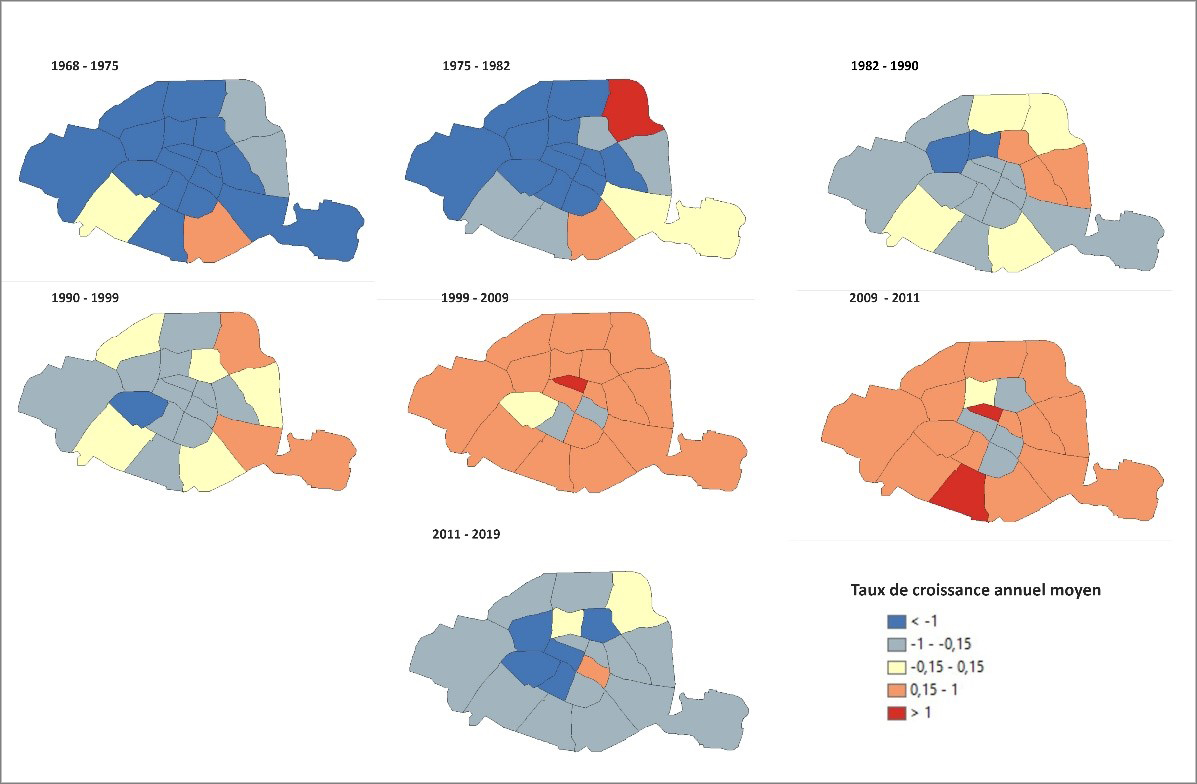
Source: INSEE, census data; cartography: Beatriz Fernández.
The 2000s heralded a reversal of this trend, with Paris gaining more than 100,000 residents. This is reflected in an increase in the number of primary residences and a decrease in the number of vacant housing units. Population growth, however, began to slow as early as 2009, which may reflect the effects of the 2008 financial crisis. As Thibault Le Corre (2019) shows, households were severely affected and banks tightened conditions for obtaining mortgages—but the crisis also led to a sharp rise in property values within the Paris city limits.
Between 2009 and 2011, Paris’s population grew more slowly than before the crisis, and four arrondissements experienced population declines (Figure 1). However, no clear spatial pattern emerged. Some central arrondissements lost residents while others made gains; the historical east–west divide became less marked. This slowdown preceded the general population decline in Paris that would begin in 2011. While population declines were moderate in arrondissements that had undergone urban development projects (e.g. 13th and 15th, in the south of the city), they were more acute in certain areas of the city core (e.g. 1st, 7th and 8th, in the center west) and the northeast of the city (e.g. 11th and 18th). [4]
These population declines are reflected not only in an increase in vacant housing units (as was the case from 1968 to 1999), but also—and above all—in a rise in the number of secondary and occasional residences. In 2019, the number of such units stood at 131,000, representing 10% of Paris’s housing stock, and in certain central arrondissements (1st, 4th, 6th, 7th, 8th) more than 20%. As in other metropolitan centers (Ardura Urquiaga et al. 2020), the increase in furnished tourist rentals (Jankel 2020) and investment properties has led to a reduction in the available housing stock in the residential sector, contributing to rising prices and the displacement of households from central areas///the center city (Le Corre 2019). While recent changes in the housing stock and the City of Paris’s attempts to regulate tourist accommodations cannot be examined here (Ortais 2023), the rest of this article offers an analysis of the age profile of the populations remaining in the center city, exploring the links between population decline and aging.
Who lives in the center city? An age profile analysis
Studies on gentrification in Paris (Delage and Clerval 2014, 2019) and on the social division of space in the Île-de-France region (Rhein 2007) demonstrate the growing social specialization of these areas. According to Delage and Clerval (2019), Paris is characterized “by an over‑representation of professionals in the media, arts, and entertainment sectors, as well as students.” These studies focus on analyses based on social class rather than age. However, in the context of demographic decline, drawing on existing literature (Hartt 2021), one may question the dynamics resulting from population loss, particularly aging.
Like France and Europe, Paris is experiencing an aging process linked to changes in the population structure in regions that have completed their first demographic transition, characterized by a decline in the fertility rate and an increase in life expectancy. [5] However, the trends in France, the Île-de-France region, and Paris are very different (Figure 2). While Île-de-France is one of the youngest regions in metropolitan France, Paris remains—despite a large student population—one of the départements with the highest average age in the Île-de-France region (Blanpain 2018).
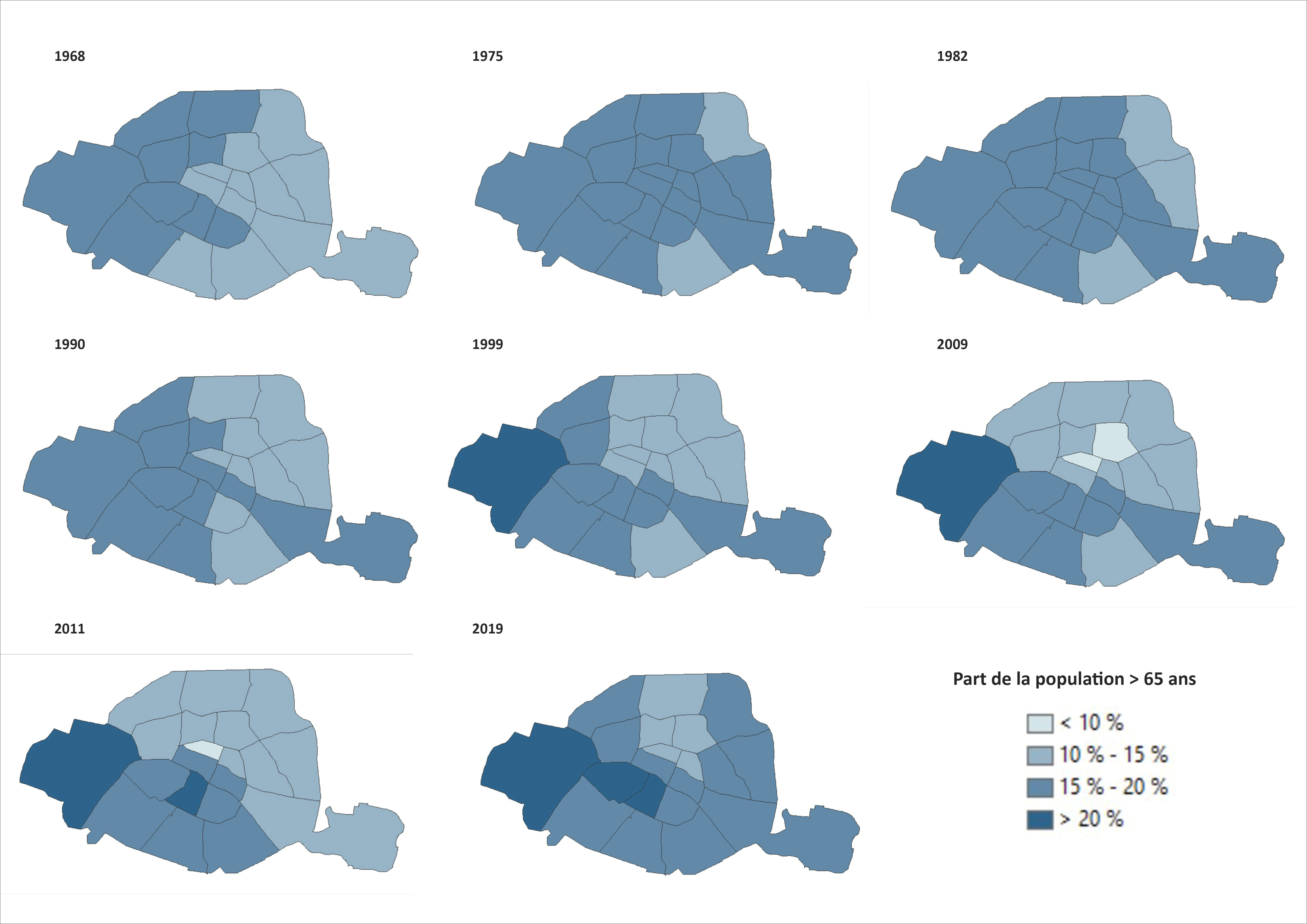
Source: INSEE, census data; cartography: Beatriz Fernández.
This phenomenon of an aging population in Paris is, however, quite unique and should be analyzed in light of demographic changes since 1968. Until the 1990s, the proportion of older adults in the capital was much higher than the French average, a gap that has narrowed over time (Figure 2). While the number of older adults was increasing in France, it decreased in Paris, with this decline coinciding with the sharpest drops in population. Between 1968 and 1999, the capital lost 450,000 residents, including 70,000 older adults. All age groups were affected by this population decline (Figure 3). People over the age of 65 was the age group that declined the fastest, including during the 1990s, which marked the first turning point in the country’s aging trend (Figure 3 also).

Source: INSEE, census data.
Between 1999 and 2009, Paris’s population growth was driven primarily by young people and adults. The number of seniors remained flat, while in France as a whole it rose rapidly. However, this trend reversed between 2009 and 2011; population growth was then driven by the elderly (+2.24%) and, to a lesser extent, by young people under 20 (+0.46%). The adult population, meanwhile, remained stable.
Since 2011, the year the first generation of the baby boom reached age 65, the population has been aging at an accelerating rate throughout Europe (Eurostat 2020); France and Paris are no exception. However, the increase in the proportion of seniors in Paris reflects a dual trend: the general aging of the population and population decline, with the former phenomenon exacerbated by the out-migration of young people and adults. Between 2011 and 2019, these two age groups experienced a definite decline in Paris: –0.92% per year for young people and –0.76% per year for adults, representing a total decrease of 122,236 people. The only age group not affected by this decline is that of people over 65. In contrast to the period from 1968 to 1999, the number of seniors increased by 1.43% per year, or 37,684 people over the entire period.
An analysis of residential migration provides a better understanding of these dynamics and helps identify the type of aging. First, net migration was negative in both 2013 and 2019 for all age groups except for young people aged 15 to 30, which supports the analyses by the Paris Urban Planning Agency (APUR), which highlight the strong presence of students in Paris (Beyne and Molinier 2019). Conversely, the age groups with the most negative net migration are adults aged 30–40 and children aged 5 and under, which points to the departure of young families from the working and middle classes (Clerval and Delage 2019; Vermeersch et al. 2019). While these shifts are well documented in the literature, there is a lesser-known phenomenon. Although there is a slight increase in the number of people leaving Paris at retirement age (compared to those leaving between the ages of 45 and 60), this trend is much less pronounced than in the Île-de-France region as a whole. In other words, Parisian seniors tend to remain in their city and in their neighborhood, which points to a phenomenon of “aging in place” [6] identified in the literature on aging in metropolitan centers (Buffel et al. 2019).
Our study sheds light on the dynamics of aging in Paris, as well as the links between this process and population decline. From a geographic perspective, the distribution of older adults is far from uniform. The cartographic analysis (Figure 4) reveals that the initial contrast between a youthful east and an aging west has faded over time, mirroring what was observed demographically. However, a new spatial pattern has emerged since 2011: the proportion of older adults is higher on the Left Bank than on the Right Bank.

Source: INSEE, census data.
However, the trend in the proportion of older adults in Paris stems from two distinct phenomena. On the one hand, in the three arrondissements with the highest proportion of older adults, [7] all located in the west, the total number of seniors has, in fact, increased only slightly. Yet these are historically aging districts, [8] experiencing significant population declines. The aging trend there is due to the combined effect of a decline in the adult and youth populations and a slight increase in the number of seniors. On the other hand, the districts where the proportion of older adults has grown most rapidly are all located in the east. These are historically young arrondissements (such as the 19th and 20th), with a significant share of public housing, and the trends point to a phenomenon of in-place aging reinforced by declines in other age groups. Our results thus demonstrate the strong interconnection between population decline and aging in Paris, which, like other European city centers (Gil-Alonso et al. 2021), appears to be an area with an older population than the surrounding suburbs.
This study highlights the contradictory dynamics at play in European metropolitan centers. Unlike the centers of U.S. metropolitan areas, where population decline has historically been associated with economic decline (Beauregard 2003; Hackworth 2015), European city centers remain attractive—and even prosperous—areas. However, their appeal to businesses, tourists, and students exacerbates housing pressures in these centers, making them unaffordable for a growing proportion of households and ultimately contributing to population declines. While these declines are, as the literature on gentrification emphasizes, socially selective, our analyses show that they are also selective from a generational perspective. The departure of young households from these areas reinforces the aging process underway in Northern countries. Thus, while research on North American metropolitan centers highlights a recent phenomenon of “youthification” (Moos et al. 2019), in Paris (as elsewhere in Europe: Gil-Alonso et al. 2021; Fernández and Hartt 2023), this process appears to coexist with an ever-increasing concentration of the elderly population.
While these initial findings invite us to question the effects of the appeal of major metropolitan areas—given that they are associated more with the image of a young, dynamic professional than with that of an older person—they also highlight two challenges for local public policy in metropolitan centers: population decline and aging, trends that are expected to intensify in the coming decades (Eurostat 2020).
Bibliography
- Atelier Parisien d’Urbanisme (Apur). 1980. “Schéma directeur d’aménagement et d’urbanisme de la Ville de Paris”, Paris Projet, nos. 19–20.
- Ardura Urquiaga, A., Lorente-Riverola, I. and Ruiz Sanchez, J. 2020. “Platform-Mediated Short-Term Rentals and Gentrification in Madrid”, Urban Studies, vol. 57, no. 15, pp. 3095–3115.
- Barbier, C. 2023. “Le mythe de la métropole attractive”, Métropolitiques, 20 March.
- Beauregard, R. A. 2002 [1993]. Voices of Decline. The Postwar Fate of US Cities, New York: Routledge.
- Beyne, L. and Molinié, M. 2019. Les 16-25 ans à Paris. Portrait social et démographique, Paris: Atelier Parisien d’Urbanisme (Apur), June.
- Blanpain, N. 2018. “De 2,8 millions de seniors en 1870 en France à 21,9 millions en 2070 ?”, in France, portrait social. Édition 2018, “Insee Références” series, Montrouge: Institut national de la statistique et des études économiques (Insee).
- Bretagnolle, A., Guérois, M. and Pavard, A. 2019. “European Small Cities and Towns: A Territorial Contextualization of Vulnerable Demographic Situations (1981–2011)”, Revue d’économie régionale et urbaine, no. 4, pp. 643–671.
- Buffel, T. and Phillipson, C. 2023. Ageing in Place in Urban Environments. Critical Perspectives, Abingdon: Routledge.
- Buffel, T, Handler, S. and Phillipson, C. (eds.). 2019. Age-Friendly Cities and Communities. A Global Perspective, Bristol: Policy Press.
- Buhnik, S. 2019. “Vieillissement en ville et villes en vieillissement”, L’Information géographique, no. 83, pp. 122–139.
- Clerval, A. and Delage, M. 2019. “L’embourgeoisement différencié de l’Est parisien aujourd’hui”, in Vivre à l’est de Paris. Inégalités, mobilités et recompositions socio-spatiales, Paris: L’Œil d’Or, pp. 79–114.
- Clerval, A. and Delage, M. 2014. “La métropole parisienne : une mosaïque sociale de plus en plus différenciée”, Métropolitiques, 8 September.
- Eurostat. 2020. Ageing Europe. Looking at the Lives of Older People in the EU. 2020 edition, “Statistical books” series, Luxembourg: Publications Office of the European Union.
- Fernández, B. and Hartt, M. 2023. “Growing Older, Growing Smaller: The Geography of Spain’s Urban Demographic Transformation”, in S. Buhnik (ed.), Rétraction urbaine et vieillissement des territoires, Londres : Wiley-ISTE.
- Gil-Alonso, F. et al. 2021. “La population des villes est-elle ségréguée en fonction de l’âge ? Quartiers vieillissants et quartiers rajeunis dans les grandes métropoles espagnoles”, Espace, populations, sociétés, 2020/3-2021/1.
- Hackworth, J. 2015. “Rightsizing as Spatial Austerity in the American Rust Belt”, Environment and Planning A: Economy and Space, vol. 47, no. 4, pp. 766–782.
- Hartt, M. et al. (eds.). 2021. Aging People, Aging Places. Experiences, Opportunities, and Challenges of Growing Older in Canada, Bristol: Policy Press.
- Jankel, S. 2020. “Locations meublées touristiques à Paris. Situation 2020 et comparaison avec sept autres grandes villes”, Paris: Atelier Parisien d’Urbanisme (Apur).
- Le Corre, T. 2019. Paris à tous prix. Analyse des inégalités par une géographie de l’investissement sur le marché immobilier résidentiel en Île-de-France, thèse de doctorat en géographie, Université Paris 1-Panthéon Sorbonne.
- Moos, M., Filion, P., Quick, M. and Walter-Joseph, R. 2019. “Youthification across the Metropolitan System: Intra-Urban Residential Geographies of Young Adults in North American Metropolitan Areas”, Cities, no. 93, pp. 224–237.
- Ortais, C. 2023. Les logements inoccupés à Paris. État des lieux, mise en perspective historique et leviers pour l’action publique, Paris: Atelier Parisien d’Urbanisme (Apur).
- Rhein, C. 2007. “Changements sociaux et transformation de l’espace”, in T. Saint-Julien and R. Le Goix (eds.), La Métropole parisienne. Centralités, inégalités, proximités, Paris: Belin, pp. 139–163.
- Vermeersch, S, Launay, L. and Charmes, É. 2019. Quitter Paris ? Les classes moyennes entre centres et périphéries, Ivry-sur-Seine: Créaphis Éditions.


